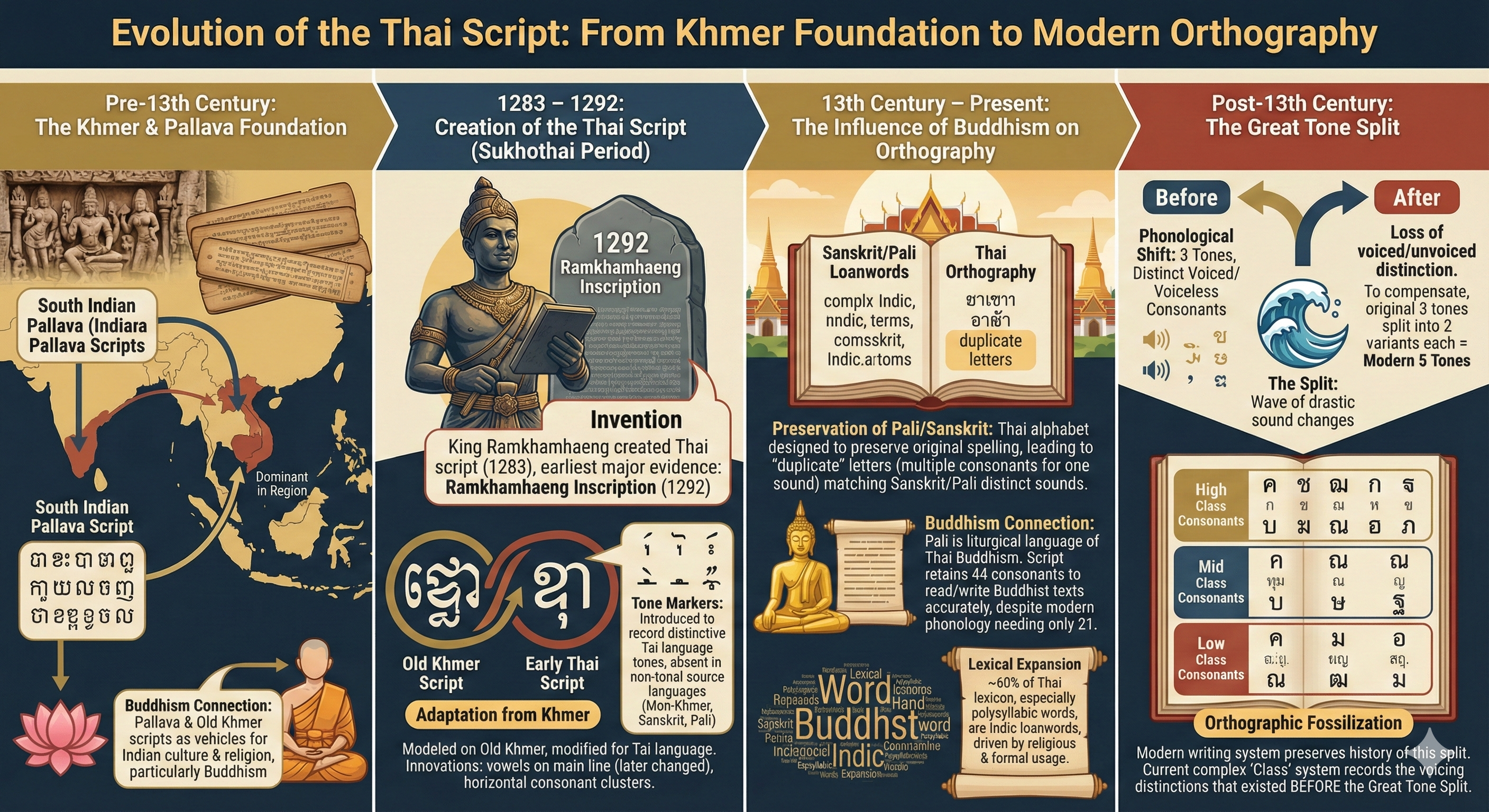
Evolution of Thai Script
From ancient Pallava origins to the modern Thai alphabet
The Thai language belongs to the Tai-Kadai (Kra-Dai) language family. While the language itself did not evolve from Sanskrit or Khmer, its script and lexicon developed through heavy borrowing and adaptation from Khmer and the liturgical languages of Buddhism.
Khmer and Pallava Origins
Pre-13th Century: Before the establishment of a distinct Thai script, the Old Khmer script (derived from the South Indian Pallava alphabet) was dominant in the region.
Buddhism Connection
The Pallava and Old Khmer scripts were vehicles for spreading Indian culture and religions, particularly Buddhism, into Southeast Asia.
Creation of Thai Script (1283)
King Ramkhamhaeng the Great is credited with creating the Thai script in 1283 CE, with the famous Ramkhamhaeng Inscription (1292) serving as the earliest major evidence.
Adaptation from Khmer
The script was modeled on the Old Khmer script but modified to suit the Tai language family. Innovations included writing vowels on the main line and writing consonant clusters horizontally.
Tone Markers
Crucially, tone markers were introduced. Since the source languages (Mon-Khmer, Sanskrit, Pali) were not tonal, the Thai script required new symbols to record the distinctive tones of the Tai language.
Influence of Buddhism on Orthography
13th Century – Present: The Thai alphabet was specifically designed to preserve the original spelling of Sanskrit and Pali loanwords.
Duplicate Letters
This resulted in "duplicate" letters—multiple Thai consonants representing the same sound (e.g., several letters for 's' or 't')—which corresponded to distinct sounds in Sanskrit/Pali but not in indigenous Thai.
44 Consonants
Pali is the liturgical language of Thai Buddhism. To read and write Buddhist texts accurately, the Thai script retained 44 consonants to match the Sanskrit/Pali inventory, even though modern Thai phonology only requires 21 distinct consonant sounds.
Lexical Expansion
Approximately 60% of the Thai lexicon, particularly polysyllabic words, consists of Indic (Pali-Sanskrit) loanwords, largely driven by religious and formal usage.
The Great Tone Split
Post-13th Century: At the time of the script's creation, the language had three tones and a clear distinction between voiced and voiceless consonants.
The Split
A "wave of drastic sound changes" known as the Great Tone Split occurred later. The distinction between voiced and unvoiced initial consonants was lost. To compensate, the original three tones split into two variants each, yielding the modern system of five tones.
Orthographic Fossilization
The modern Thai writing system preserves the history of this split. The complex "Class" system (High, Mid, Low consonants) used today is actually a record of the voicing distinctions that existed before the Great Tone Split occurred.
For more details, see our Origin of the Thai Tonal System article.
Visual Timeline
This infographic illustrates the evolution of the Thai script from its ancient origins to the modern alphabet.