
The Tones of Standard Thai
A phonetic and phonological analysis of the five lexical tones
Standard Thai is a tonal language wherein variations in fundamental frequency (f0), or pitch, function as discrete phonemic units essential for lexical distinction.
While traditionally categorised into static and dynamic groups, modern acoustic analyses reveal a complex system undergoing synchronic change, particularly within the speech of younger generations in Bangkok.
The five lexical tones of Standard Thai are the Mid, Low, Falling, High, and Rising tones.
The Five Tones: Acoustic Profiles and Trajectories
Although often taught as fixed pitch shapes, the realisation of Thai tones involves dynamic movements. Acoustic studies classify the Mid, Low, and High tones as "static" (or level) and the Falling and Rising tones as "dynamic" (or contour), though this binary distinction is increasingly challenged by modern data.
The Mid Tone (Siang Saman)
- Trajectory: Often described as level, the Mid tone typically begins in the middle of the speaker's vocal range and exhibits a slight, monotonic fall toward the tonal offset.
- Frequency: It is the most frequently occurring tone, accounting for approximately 34% of words in large corpora. This dominance is driven by high-frequency grammatical words like kaan and thii.
The Low Tone (Siang Ek)
- Trajectory: Begins at a lower pitch than the Mid tone and falls gradually to the bottom of the speaker's vocal range.
- Differentiation: Distinguished from the Mid tone by its lower onset and offset. In fast speech, the distinction can become ambiguous to non-native listeners.
The Falling Tone (Siang Tho)
- Trajectory: A dynamic contour tone with a convex shape. Starts with a high onset (often the highest in the system), rises slightly or plateaus, then falls sharply.
- Peak Alignment: The fundamental frequency peak occurs relatively early (word-medial), aligning with the first mora of the syllable before the sharp descent.
The High Tone (Siang Tri)
- Trajectory & Evolution: Historically described as a "high level" tone (1911–1962), the modern High tone has undergone significant phonetic evolution. In contemporary Bangkok speech, particularly among younger speakers, it is realised as a mid-rising or concave contour.
- Reclassification: Due to this shift, linguists argue the High tone should be reclassified as a contour tone alongside Rising and Falling tones.
The Rising Tone (Siang Chattawa)
- Trajectory: Exhibits a concave shape similar to the modern High tone but operates in a lower register. Dips low (often reaching the bottom of the pitch range) before rising sharply.
- Distinction: Distinguished by having the lowest onset of all five tones, with a rise that begins later than the High tone. Younger speakers frequently produce this with creaky voice (vocal fry).
Tonal Realisation in Connected Speech
The acoustic realisation of these tones shifts when words are strung together in sentences, influenced by speaking rate and intonation.
Adaptive Scaling
Thai speakers maintain tonal distinctiveness in fast speech not by truncating tone shapes, but by adjusting the velocity of pitch change to ensure full contour realisation.
Global Lowering
Tones in sentence-final positions often undergo "global lowering" due to a low boundary tone (L%), causing the entire pitch contour to shift downwards.
Onset Raising
In fast speech, there is a tendency for the onset pitch of tones (particularly Mid, Low, and Rising) to be raised, positioning the contour higher.
Orthographic Encoding (Writing)
The Thai writing system, an abugida rooted in the Indic tradition, encodes these tones through a complex interaction of consonant class, vowel length, and syllable endings.
Consonant Classes
Consonants are divided into High, Mid, and Low classes. This classification acts as a fossilised record of historical voicing distinctions that existed before the "Great Tone Split."
Live vs. Dead Syllables
Live syllables (ending in long vowels or sonorants like /n/, /m/, /y/) can carry any tone. Dead syllables (ending in short vowels or stops like /p/, /t/, /k/) are acoustically restricted—they cannot naturally carry Mid or Rising tones and default to Low or High/Falling depending on consonant class.
Tone Markers
Four diacritics (mai ek, mai tho, mai tri, mai chattawa) modify the inherent tone. However, their effect is not uniform—for example, mai ek produces a Low tone on Mid/High class consonants but a Falling tone on Low class consonants.
Visual Guide to Thai Tones
This infographic provides a comprehensive visual overview of the Thai tonal system, including pitch contours, Thai names, and practical examples.
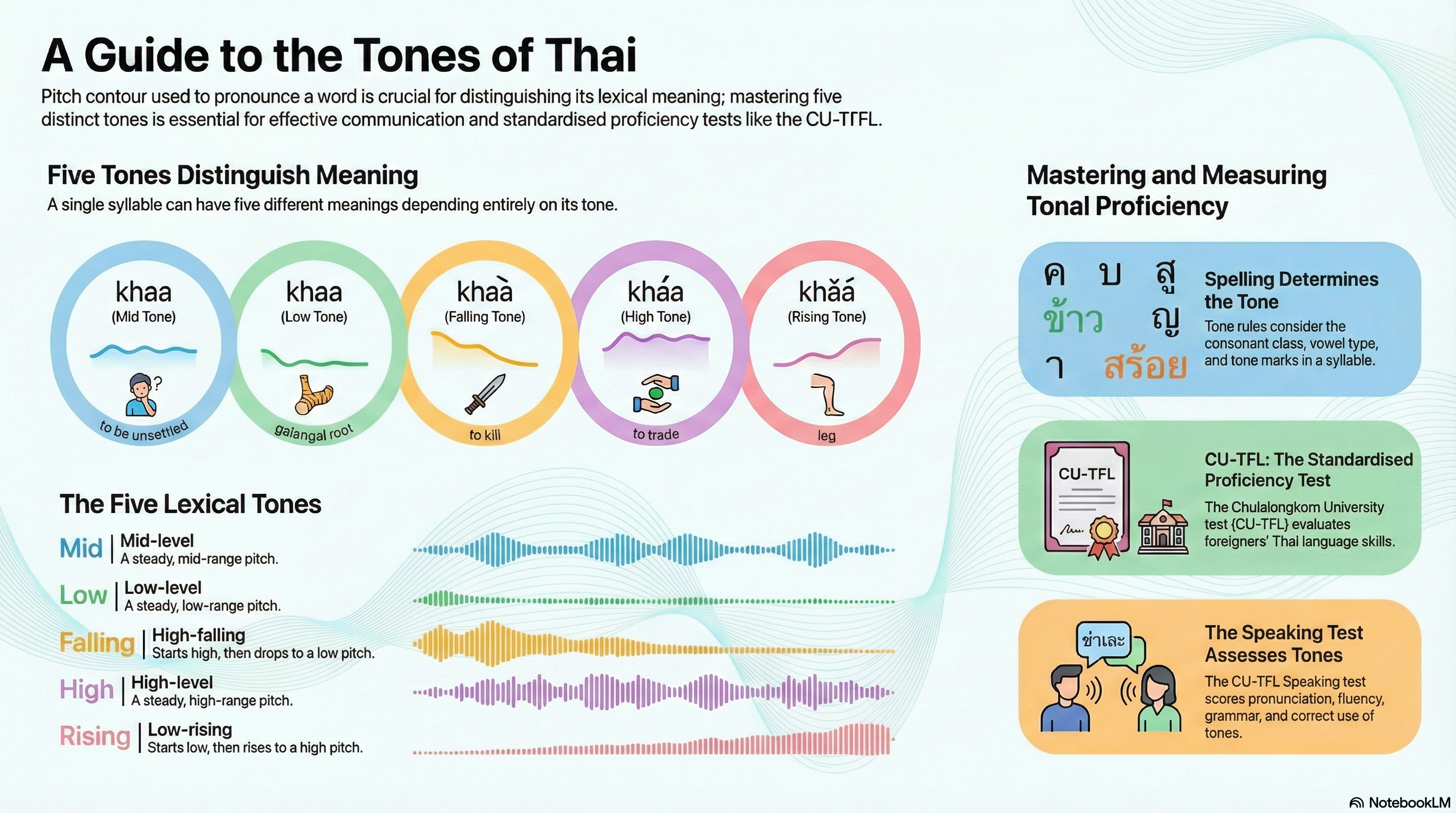
Click to view full size • Guide to Thai Tones Infographic